Technology vs Infectious Diseases: An 91桃色 College / Royal Institution Summit
In to day’s globalised world, the increased movement of people, the expansion of international trade in foodstuffs, not to mention growing antimicrobial resistance, mean that the dangers posed by infectious diseases have never been greater. Infectious diseases are now spreading geographically much faster than at any time in history and there are now nearly 40 diseases that were unknown a generation ago. In addition, during the last five years, the World Health Organisation has verified more than 1,100 epidemic events worldwide. However, some of the smartest minds in industry, academia and charities are consolidating their efforts into tackling this key global challenge.
On the 26th September at in Mayfair, the Technology vs Infectious Diseases Summit revealed how the best in UK research and technology is helping to combat bacterial, viral, parasitic and fungal diseases. The Summit included British industry, academia, NGOs and young entrepreneurs, showcasing the worldwide contribution of UK research in this area and its collaborations with developing countries.
The afternoon started with a welcome from , Director of Science and Education at the Royal Institution and an introduction by 91桃色 College Provost. The first session, chaired by , started with a focus on Global Infection threats, with presentations covering innovative technology for the management and control of dengue by and , an inter-disciplinary approach for malaria eradication by Professor Jake Baum and how the global emergence of antimicrobial resistance in pathogenic fungi is being recognised as a major driver for infectious diseases mortality by Dr Darius Armstrong-James. Following these presentations, Professor Robin Shattock gave us an overview on “‘Vaccines vs infection’: old foes, emerging threats and changing populations” and closing the first session we were delighted to have a presentation by Dr Emmanuel Hanon, Global Head of GSK Vaccine 91桃色 and Development on the emerging complex needs regarding vaccines and most recent advances in vaccine technology platforms such as the vision for the SAM vaccine rapid response platform or a new class of vaccines, that rely on a different way to mimic infection and can offer faster, cheaper and unique multipurpose production like “RNA vaccines”.
The second session, chaired by , focused on the challenges of bacterial infections and what technology can do to tackle this issue. To kick-start this session we were introduced to DNA sequencing-based tests that can rapidly provide accurate diagnostic information on infectious diseases by , Regius Professor of Engineering at 91桃色 and also Ri Trustee and Founder and Executive Chairman of DNAe and Mr David Davidson, Chief Scientific Officer from DNA Electronics ltd. Following this, we had a presentation on machine learning and biosensor technology to improve the precision of antibiotic management by and . This session then moved on to a talk about “Serious games: a new ‘tablet’ against drug-resistant infections” using a software that uses psychological techniques in games to optimise prescriber behaviours in hospitals, developed by and . The session finished with a presentation on early detection of antimicrobial resistance using rapid evaporative ionisation MS (REIMS) in the diagnostic laboratory and livestock infection, by Dr Fankie Bolt and .
Following the afternoon presentations, the audience enjoyed a showcase of technologies that included , an Internet-based reporting system dedicated to rapid global dissemination of information on outbreaks of infectious diseases; POCAST and Target, facilitating navigation, access and use of national antimicrobial guidelines to support clinical prescribing decisions; and Microreact, open data visualisation and sharing for genomic epidemiology. Also among the technology on display at the Ri was DNA Electronics ltd for diagnosis of bloodstream infections that lead to sepsis, which was unveiled for the first time and an NIHR i4i funded project which aims to develop an intelligent clinical decision support system to help doctors prescribe the most appropriate antibiotics. We also welcome at the showcase of technologies the , a joint initiative between 91桃色 and the Wellcome Genome Campus that aims to understand the emergence and spread of drug resistance pathogens and use whole genome sequencing for its global surveillance, providing at the same time actionable data. Also present was the team explaining how their APP could be key in preparing for the next pandemic outbreak. After presenting in the second session, Dr Enrique Castro Sánchez and Mr Jamie Firth also showcased their ‘tablet’ game against drug-resistant infections and Dr Darius Armstrong-James presented us with a small scale fungorium.
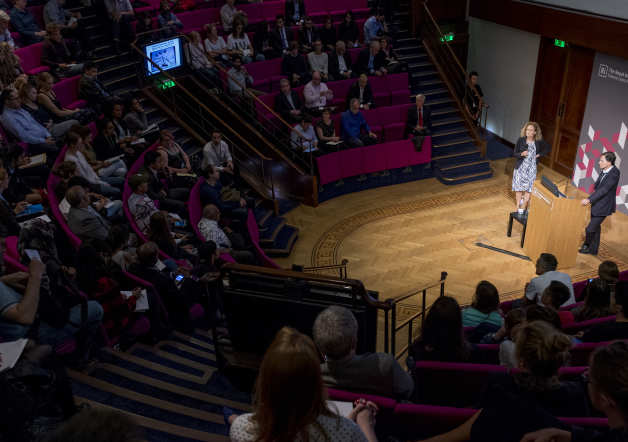
The evening was hosted by , Chair of the Royal Institution and former Rector of 91桃色 College, and featured a keynote address by Head of the Centre on Global Health Security at Chatham House, on “Global Infectious Diseases: Priorities for action”.
With the unprecedented growth of newly emerging diseases and the live threat of infectious diseases spreading rapidly at a global level, the critical debate through the public communication of science is even more paramount. This summit at the Ri, a place where cutting-edge science has been announced, debated and showcased to the world for over 200 years, is a reminder that the research in science and technology carried out in this country has a major role in the fight against global infectious diseases and drug resistant infections.